
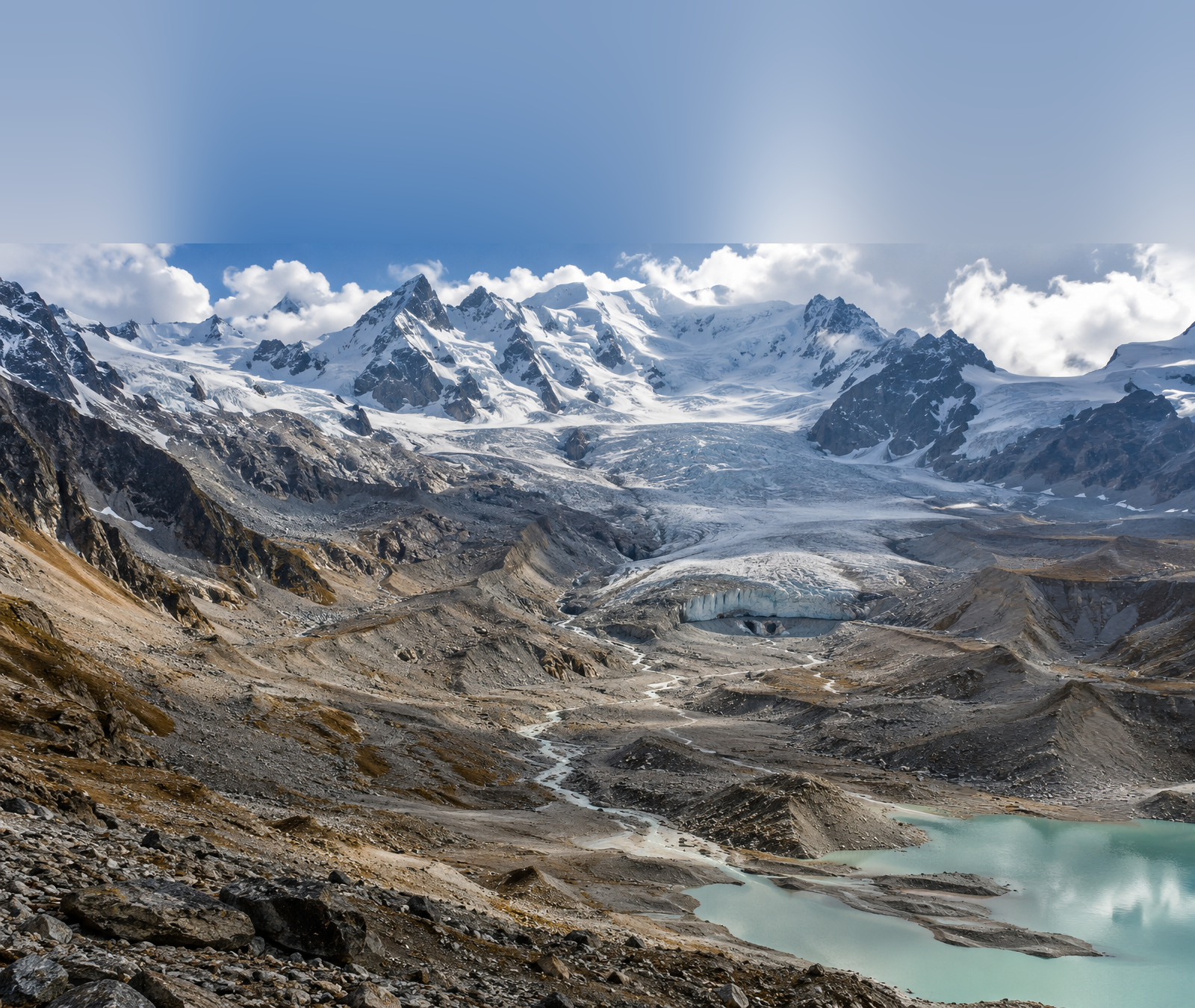
The world’s glaciers are still losing ice at an extraordinary rate. The World Meteorological Organization’s latest global assessment reports that glaciers outside the Greenland and Antarctic ice sheets lost an estimated 408 ± 132 billion tonnes of ice in the 2025 hydrological year. That amount of meltwater contributed roughly 1.1 ± 0.4 millimetres to global mean sea level in a single year.
What makes the current period particularly striking is its persistence. According to WMO, 2025 was the fourth consecutive year in which all 19 major glacier regions recorded a net annual mass loss. There was no large glacier region that finished the year with a positive overall balance.
A record-breaking sequence, not a single bad year
The global retreat cannot be explained by one isolated heatwave or one poor snow season. WMO and the World Glacier Monitoring Service show a sustained negative trend across mountain regions. The period from 2022 to 2024 produced the largest three-year glacier mass loss on record, and 2025 extended that exceptionally negative sequence.
In Europe, the Alps are among the clearest examples. In High Mountain Asia, the Andes, Alaska, western Canada, the Caucasus and many other regions, long-term measurements and satellite observations show thinning, retreat and fragmentation. Local weather still creates large year-to-year differences, but the multi-decadal direction is overwhelmingly downward.
Why glacier loss matters far beyond the mountains
Glaciers act as natural water stores. Snow accumulates at high elevations and is gradually released as meltwater during warmer months. As glaciers initially melt faster, river flow can temporarily increase. But once enough ice has disappeared, the long-term reserve becomes smaller and summer meltwater contributions eventually decline.
This matters for communities that depend on mountain water for drinking supplies, irrigation, hydropower and ecosystems. UNESCO’s 2025 World Water Development Report describes mountains and glaciers as crucial water towers and warns that accelerated cryosphere loss is changing the timing and reliability of water availability.
Sea level and mountain hazards are part of the same story
Unlike melting sea ice, melting land-based glaciers add water directly to the oceans. The cumulative loss since 1975 is estimated at roughly 9,000 billion tonnes, corresponding to about 25 millimetres of global sea-level rise. At the same time, retreating glaciers expose steep rock walls, form new lakes and can destabilise frozen terrain.
The exact future of individual glaciers depends on altitude, snowfall, topography and future warming. Some very high or large glaciers will survive much longer than small low-elevation ones. But the latest global observations leave little doubt about the overall trend: mountain glacier ice is shrinking rapidly on every continent where glaciers occur.