
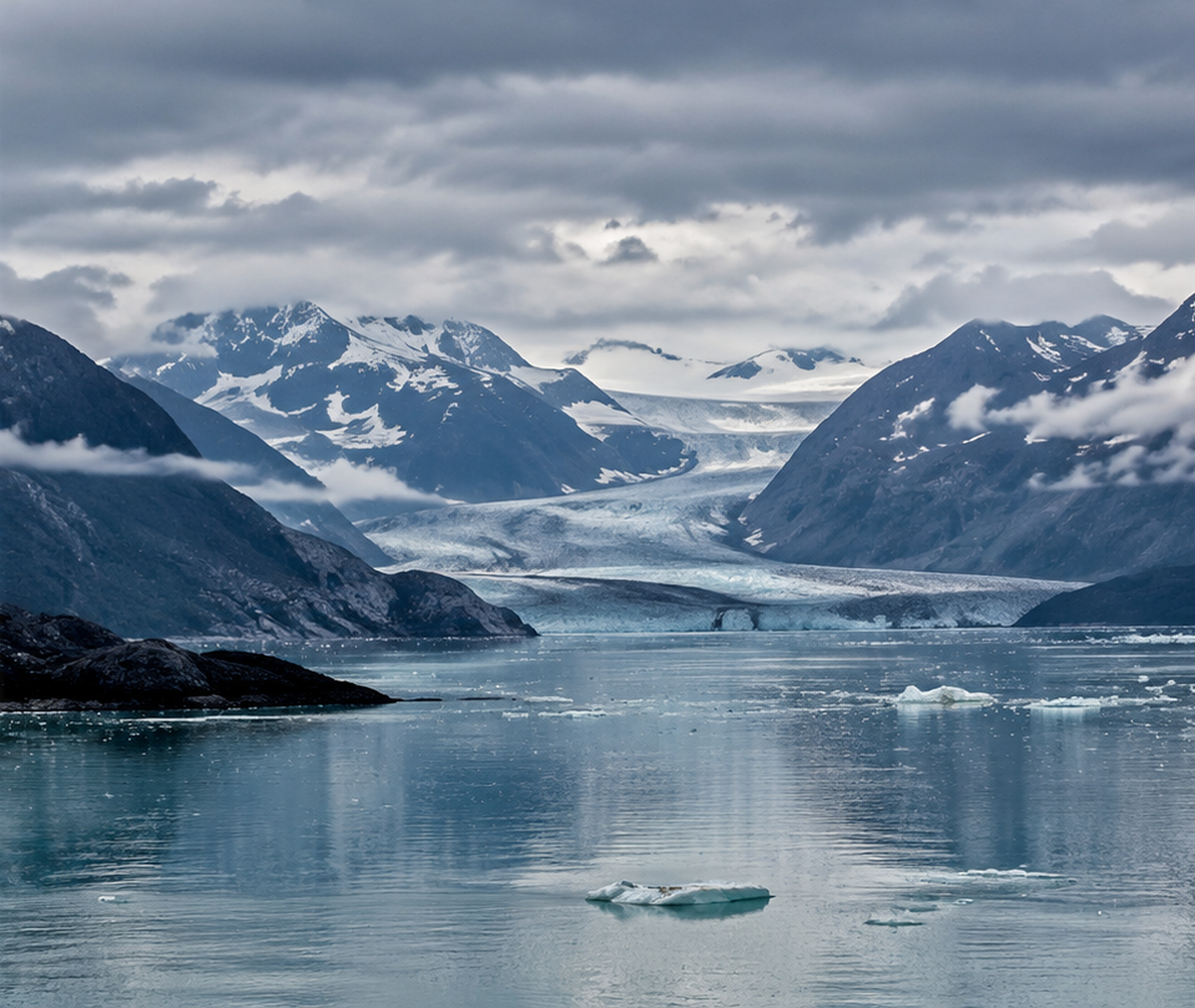
Which glacier is retreating the most on Earth? The scientifically correct answer is more complicated than a single global ranking. Glaciers are measured in different ways: terminus retreat, thickness loss, total ice volume, mass balance and area change. There is no single internationally maintained table that declares one universal “fastest-shrinking glacier” across every metric.
Columbia Glacier: one of the clearest extreme cases on Earth
For long-term terminus retreat, Alaska’s Columbia Glacier is one of the most dramatic and best-documented examples in the world. The glacier flows from the Chugach Mountains into Prince William Sound and began a rapid retreat around 1980.
More than 26 kilometres of retreat since 1980
According to the U.S. Geological Survey, by late 2025 the Main Branch had retreated more than 26 kilometres from its 1980 position. NASA had already documented more than 20 kilometres of retreat by 2024, together with major thinning.
More than half of its thickness and volume lost
NASA reports that Columbia Glacier has lost more than half of its total thickness and volume since the 1980s. In some years, the glacier front retreated by more than one kilometre.
Why Columbia Glacier can retreat so fast
Columbia is a tidewater glacier. Its ice flows directly into a fjord, where iceberg calving removes mass from the glacier front. Once the terminus retreated away from stabilising underwater and rocky features, it entered deeper water and became increasingly unstable.
This means climate warming is not the only factor controlling the exact speed of retreat. Fjord geometry, water depth, calving dynamics, ocean conditions and the position of the glacier front all influence how quickly a tidewater glacier can pull back.
Why it is safer to say “one of the fastest” rather than “the world record”
Other glaciers in Alaska, Patagonia, Greenland, the Himalaya and West Antarctica have also experienced exceptional losses, but they are not always measured with the same methods or over the same periods. A glacier that leads in frontal retreat may not lead in total mass loss.
That is why Columbia Glacier is best described as one of the world’s most rapidly changing glaciers, not as an uncontested global number one.
The global picture is even more alarming
The World Meteorological Organization reports that the years 2022 to 2024 produced the largest three-year glacier mass loss on record. In the 2023/24 hydrological year alone, monitored reference glaciers lost about 1.3 metres of water equivalent on average, representing roughly 450 gigatonnes of ice and about 1.2 millimetres of global sea-level rise.
By 2025, five of the previous six years had ranked among the fastest glacier-retreat years ever observed. Columbia Glacier is therefore not an isolated anomaly: it is one of the clearest individual examples of a global acceleration in glacier loss.